From Data to Solutions: What are the takeaways of the World Café session?
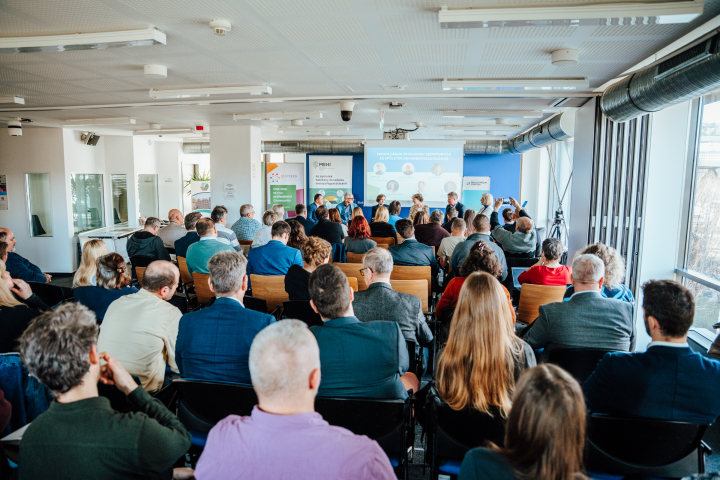
Energiaklub, MEHI, and the Climate Protection Alliance organized a full-house municipal conference, during which participants discussed building related energy efficiency in small groups across various topics in the final part of the event in a world cafe format.
At the desk covering the topic of energy management, participants explored the energy-saving opportunities inherent in smart metering and data analysis. The main topic was energy management systems - these do not allow for remote intervention (which is referred to as a building management system), but by displaying consumption, they make it visible if usage is significant outside of operating hours. Few people know that most public buildings already have, or can request, smart electricity meters, and that data from these meters can be accessed via a web portal. So, with little attention and monitoring the data, these problems can be eliminated. This requires a responsible person who takes ownership of the issue and has the authority to implement cost-saving measures - such as adjusting the thermostat - meaning strong leadership support is also necessary.
In many municipalities, there is a problem and confusion surrounding utility meters; it is often unclear who is responsible for paying what (e.g., local government, institutions, government, school districts). Sorting this out is a prerequisite for introducing an energy management system, but it can also lead to cost reductions on its own.
A typical objection to metering and energy management is that if an institution saves money, its budget will be cut the following year. Therefore, a different type of incentive must be provided (a bonus or direct additional institutional funding): in many foreign municipalities, 50% of the “unincurred energy costs” resulting from measured energy savings is made available to the institution for discretionary use the following year, while the local government spends the other 50% on further energy efficiency improvements.
A good example was a climate officer from a small town (called Gabriella Zagyva, Ambassador of the European Climate Pact) who developed her own app to collect data from institutions’ meters; this is also a great help, although it does not show consumption during closing hours.
Energy management is less complicated than many people think - after all, smart meters are already available in most public buildings, and the consumption data they generate can be automatically integrated into an energy monitoring system. When used effectively, this system can yield significant savings in a short period of time, at virtually no cost. When selecting the necessary software, it is worth noting that some solutions are also suitable for energy community management.
During the discussion on innovative building technologies, we focused primarily on specific developments and less well-known technological solutions. Planet Energy Magyarország Kft. has already contributed to the energy modernization of hundreds of municipal and government buildings as an energy expert, designer, and project manager. During the discussion, we examined two specific projects in detail: the Gellért Campus building of Corvinus University of Budapest, which was inaugurated last year, and the Szent Ferenc Hospital in Budapest. The experts emphasized how important it is to continuously monitor and “fine-tune” the systems for at least a year following energy efficiency and mechanical renovations.
Elektro-Kamleithner Kft. provides comprehensive services in building automation: its open, distributed-intelligence systems are scalable in the long term and ensure data-driven operations for facility managers. Based on their experience, this approach yields an average energy savings of approximately 30% and enables more transparent, sustainable operations.
A consultant from Abud Mérnökiroda spoke about a kindergarten renovation in District XVIII, which incorporated numerous innovative elements: for example, thermal insulation and a thermal accumulator implemented using prefabricated panels.
The lesson learned was that renovations should not be designed using a one-size-fits-all approach; when choosing between technologies, factors other than the building’s energy characteristics and possibilities may come into consideration, such as fire safety (VRF technology is not always ideal), lack of space (in which case PIR insulation may be a viable option), or noise impacts (heat pumps). Dynamic simulation, which models building usage, can also help in finding the ideal solutions.
Regarding decarbonizing heating, the main topic was heating with firewood. A case study about the village of Etes was described: the discussion touched upon the firewood crisis as well as the importance of raising awareness about firewood combustion. For example, it might be a good idea to display awareness-raising posters in doctors’ offices or to inform the public about air pollution levels. Finally, the experts also shared their views on the operating principles of 5th-generation district heating and the importance of baseboard insulation.
At the roundtable focused on encouraging residential building renovations, experts included project managers from condominium management firms (Energesco Kft., Projektdoctor Kft.) and an expert from the Budapesti Közművek, who coordinates the Budapest Green Panel Program. An important topic was encouraging the modernization of condominiums, where the effective facilitation of residents’ meetings and EKR financing for attic floor insulation were discussed, and the use of solar panel systems was also covered in detail. Here, the experts briefly outlined the current legal framework, the possibility and necessity of forming energy communities within a condominium, and the ways in which solar energy can be utilized in condominiums with minimal loss (common areas, elevators, heating domestic hot water, ground-floor retail spaces, and power supply for service providers). The issues of storage and energy sharing with other municipal institutions were also raised.
The Budapest Green Panel Program was also discussed, with several innovative elements highlighted: the decision-making documentation, namely 100% funding for the planning phase, and the social component, where, with the help of the Hálózat Foundation, even lower-income residents are able to cover the cost of renovation. This allows even those condominiums where not everyone lives in affluent circumstances to participate in the modernisation.
We explored the issue of one-stop shops from multiple angles, as the group included both those who already operate such renovation consulting services and those who are currently considering opening one. The role of county governments, their coordination capabilities, and the involvement of county chief engineers were raised, but those present did not view cooperation between the capital city and the districts as realistic. Those with experience in consulting emphasized the importance of both marketing and raising awareness: even if an organization offers free consulting, if owners are unaware of it or do not understand the benefits of modernisation, demand for the service will be very low. In the case of condominium units, it is particularly difficult to convince residents of the benefits alongside reduced utility costs, but rising property values and increased comfort can persuade many residents to support the modernization of the entire building.
In the group focusing on financing, local governments were asked about direct funding opportunities available beyond EU funds, such as ELENA, Two existing Hungarian projects as examples were mentioned that have already secured ELENA funding - but they are not particularly encouraging; the EIB requires extensive preparation and genuine implementation. The issue of project aggregation came up: are there any foreign - or perhaps domestic - examples of this? Furthermore, from the banks’ perspective, is there any openness to providing green loans to finance larger municipal projects or aggregated projects?
EMIT was discussed - the energy-saving plan currently applicable to municipalities - which is typically not taken very seriously and is rarely implemented to a high standard. The situation is similar to EMIS data uploads (MEKH data collection on consumption and building data); there are no penalties for either, so many municipalities do not prepare the plan and/or do not upload the data.
One participant noted that while the inspection of heating systems over 70 kW is also mandatory, they themselves do not see what useful additional information the inspection results provide to the operator (110,000 systems would be subject to this requirement, but the otherwise mandatory inspection was completed for only 3% of them).
There was a thorough discussion about the EKR: the energy efficiency surcharge appears on the municipality’s bill, and it is advisable to offset this with an energy efficiency project; discuss this with the service provider - and, if necessary, seek the assistance of an energy auditor. The municipality can account for various measures in the EKR (see the relevant chapter of the guide titled “Toward an Energy-Efficient Building Stock” available in Hungarian), such as the attic floor insulation. A question was raised regarding whether there is a grant program for condominium upgrades; currently, such programs are limited to the replacement of remotely readable cost allocators in district-heated apartments. However, the insulation of heating pipes in condominiums is also eligible for funding. This topic also came up at another table: according to one mayor, the program isn’t taking off in certain towns because people are reluctant to clear out junk and other belongings from their attics, and since they wouldn’t know where to put them anyway, they’re afraid they’d end up burning them.
As a bit of an oddball topic, those interested also had the opportunity to discuss the upcoming new climate law. The recently published civil society concept is open for comment throughout March, and the initiators are also looking forward to other organizations and local governments joining the effort.