RenoPont Relaunched: Personalised Recommendations for Home Renovation Combined with Renewable Energy
The latest surge in winter heating bills has once again highlighted the poor energy performance of Hungary’s building stock. High household utility costs are not primarily the result of extreme weather conditions, but of the high proportion of outdated, poorly insulated buildings and homes with inefficient heating systems. In this context, access to clear, reliable and personalised information is a key issue for anyone planning a home renovation.
This is the aim of the renewed renopont.hu, where, alongside the existing knowledge base, comprehensive guides and easy-to-use, question-based tools now help users navigate the world of renewable energy solutions.
Heating bills reflect a structural problem
According to official data, around 42% of Hungary’s final energy consumption is linked to buildings. The reduction in energy use seen in recent years has been driven mainly by milder winters and household saving measures, rather than by the widespread uptake of energy-efficient renovations. As a result, when a colder winter arrives, utility costs rise sharply again.
Expert estimates suggest that more than 3% of the building stock would need deep renovation each year, equivalent to around 140,000 homes annually. This scale of renovation cannot be delivered through market forces alone, while the cost of delay continues to grow: higher energy bills, poorer air quality, and missed climate targets.

Not generic advice, but solutions tailored to real-life situations
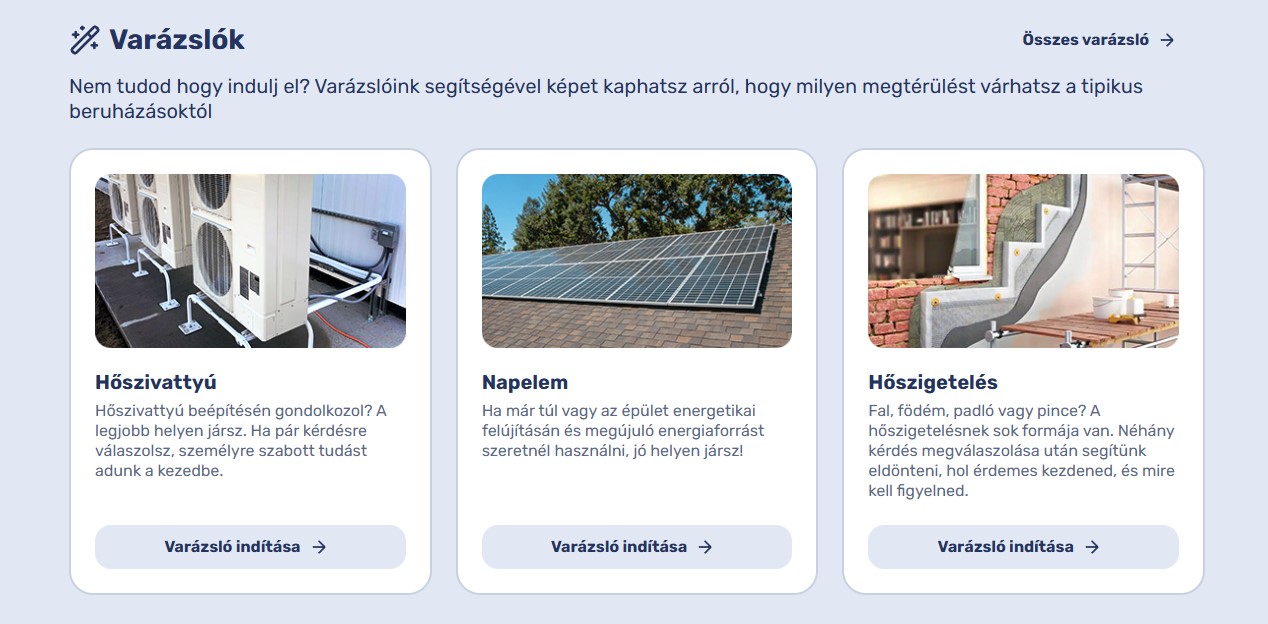
One of the most important innovations of the renewed RenoPont is that, after completing a short, click-through questionnaire, users receive recommendations tailored to the specific characteristics of their own home, rather than generic advice.
A typical example: a homeowner living in a detached house wants to reduce energy bills while keeping their existing boiler or stove; the property is located in a green area, plot space is limited, and the owner wants to minimise structural alterations. In such cases, RenoPont does not recommend a full system replacement, but presents hybrid solutions instead—for example, an air-to-water heat pump added to an existing radiator system, or an air-to-air heat pump (heating and cooling air conditioner) that can reduce the use of gas- or wood-based heating on a room-by-room basis.
For each option, the website clearly explains the benefits, limitations and key considerations to weigh before making a decision. Only after this personalised guidance do users gain access to the broader knowledge base and detailed technical background materials.
Renewable energy: no universal formula, but a solution for everyone
RenoPont’s new approach is based on the principle that not every renewable technology is suitable for every building. Heat pumps, photovoltaic systems (solar panels) or solar thermal collectors can all be good solutions—but only if they match the building’s characteristics, the household’s living situation and the household’s financial situation.
The available guides therefore distinguish between detached houses and apartment buildings, solutions requiring minor or major interventions, and situations where it makes sense to retain an existing heating system versus when replacement is justified.
Online knowledge and personal consultancy in one system
Following online exploration, users can also receive personalised support through RenoPont advisory offices or via online consultations. The advisory process accompanies homeowners from decision-making through to implementation, helping them avoid poor choices and unnecessary costs.
The renewed RenoPont aims to replace uncertainty with clear points of reference, and guesswork with real, informed choices—whether the focus is on energy efficiency or renewable energy.
Press contact – available for interviews:
Ilona Illésné Szécsi,
Energy Efficiency Project Manager, Energiaklub Climate Policy Institute,
Coordinator of the RenoPont One-Stop-Shop Home Renovation Advisory Network.
Ilona Szécsi-Illés received the Portfolio Green Awards – Green Role Model of the Year award in 2024. She founded and leads the RenoPont residential renovation advisory network, which provides free, independent advice nationwide for people planning home renovations. She communicates complex issues in a clear and accessible way, supported by concrete figures, including:
• Why high heating bills are driven by the condition of the building stock rather than the weather.
• Which renovation decisions lead to real and lasting reductions in energy costs.
• How personalised advisory tools help avoid poor investment decisions.
• The correct order of renovation steps, and why heating system upgrades should not be undertaken without proper insulation.
• Why external insulation (walls, roof/attic and windows) should be the first step: in a typical detached house, 25–35% of energy is lost through walls, around 25% through the roof, and 10–15% through windows.
• The scale of achievable savings: for detached houses built between the 1960s and 1980s, heating modernisation alone can reduce heating-related energy use by 50–55%, while a comprehensive deep renovation can deliver 70–80% energy savings.
• How renovation not only lowers utility costs but also improves comfort and increases property value: after a comprehensive upgrade, a home’s market value can increase by up to 50%.