Let’s Relaunch a Reformed Home Renovation Programme and EEOS!
In Hungary, there is an agreement between the key players of the construction industry that the poor condition of the Hungarian building stock and the slow pace of building renovations justify the significant changes in the field of building energy efficiency. As most renovation projects were put on hold following the elections, and the construction industry is currently operating at very low capacity, it is important that new or reformed energy efficiency programmes are launched as soon as possible. Three important programmes could significantly support the relaunch and revival of the renovation market: firstly, grant schemes supporting single-family homes; secondly, the reform of the Energy Efficiency Obligation Scheme (EEOS); and thirdly, programmes for multi-apartment buildings. The first two were assessed by one-stop shop providers and the EU Peers members of the Hungarian community, whose recommendations and proposals were compiled by the Energiaklub Climate Policy Institute and submitted to the Ministry of Economy and Energy.
The Home Renovation Programme (HRP), which ran between 2024 and 2026, contained several forward-looking elements, meaning that it could be relaunched relatively quickly with some minor adjustments. The views and recommendations of one-stop-shop service providers regarding the HRP are particularly relevant, as they provided practical assistance to homeowners participating in the programme with energy performance certification, grant applications, bank administration, contractor selection and grant reporting. Thus, they have gained first-hand experience of the programme’s strengths and weaknesses. They considered the most important elements to retain to be the 30% energy efficiency target which focuses on detached houses built before 2007, nationwide coverage, the low level of own contribution required, and the availability of preferential loans. However, changes are needed in several areas, as far fewer people applied for the scheme than the available budget would have allowed. The highly bureaucratic application process was cited as the main reason for the modest level of interest. Therefore, the most important recommendations were to allow applications to be submitted online (until now, applications could only be submitted on paper), to remove the requirement to take out a loan, and to eliminate administrative procedures that requested unnecessary, duplicated data. Furthermore, they recommended that major refurbishments be incentivised with higher non-repayable grants, that the costs of preparing grant applications be eligible for funding, that the deadline for payment of the final invoice be adhered to, and that the programme be accompanied by a nationwide awareness-raising campaign.
Another very important scheme is the Energy Efficiency Obligation Scheme (EEOS), under which energy suppliers and traders are required to achieve energy savings among end users every year. This programme does not require public funding, meaning that energy efficiency projects could be launched through regulatory reform, even without budgetary or EU funds. Under this scheme, service providers carried out free attic-floor insulation in numerous municipalities, but due to the low price of Certified Energy Savings (CESs), these programmes have been halted, and few other energy efficiency projects have been launched under the EEOS since the elections. The Ministry of Economy and Energy (MEE) is prioritising the EEOS and aims to make the system more efficient and predictable and eliminate corruption through new regulations and increased monitoring. The views of stakeholders were sought at several workshops, and in August a structured questionnaire was used in an effort to gather the views and suggestions of as many participants as possible (such as obligated entities and auditors) to the decision-makers.
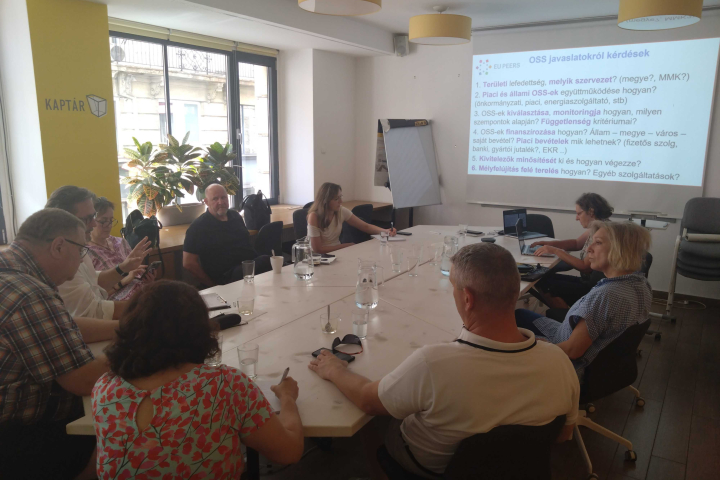
We considered it important that companies directly involved with homeowners carrying out renovations in single-family and multi-apartment buildings should have the opportunity to express their views on the EEOS system as it stands, so we brought together the Hungarian EU Peers community, discussed the topics covered by the questionnaire, and also debated the proposals that emerged. Based on the comments, the most significant issues were the unpredictability of the regulatory framework, the volatility of CES prices, and the lack of transparency in bilateral contracts involving major debtors. Most of the proposals related to reducing administrative burdens, strengthening controls, the method of passing on EEOS charges, transparent bilateral contract negotiations, the predictability of CES prices on the exchange, and proportionate taxation (VAT). In general, EU Peers members would like the EEOS to provide stronger incentives for complex residential renovations (both single-family homes and multi-apartment buildings) and to contribute more effectively to the renovation of public buildings as well. All of this is also in Hungary’s interest, because improving energy efficiency increases energy security and energy independence, reduces utility bills and running costs, and enhances the comfort of homes and workplaces as well as the value of properties.
We have submitted the recommendations for fine-tuning the HRP and reforming the EEOS to the Ministry of Economy and Energy, and we hope that decision-makers will incorporate into the renewal of these programmes the recommendations of those who work in practice on the implementation of building renovations and accompany homeowners along the often challenging path from planning to implementation.