Full house conference to support the domestic implementation of the EPBD in Hungary
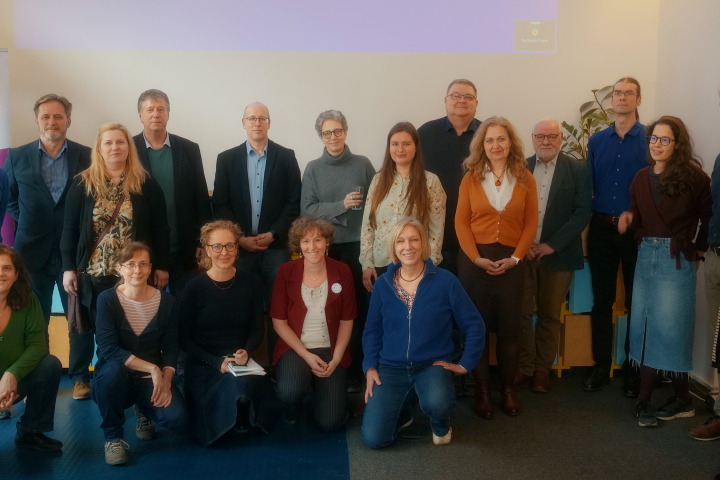
On February 12, amid widespread professional interest and with the participation of numerous EU Peers members, the Hungarian Energy Efficiency Institute presented its publication titled “Guide to the Transposition of the Energy Performance of Buildings Directive (EPBD) in Hungary”.
In collaboration with Hungarian and European experts, the guide provides a detailed overview of the EU directive, which Hungary must transpose into national law by spring 2026 and which will fundamentally define the framework for the renovation, operation, and construction of the domestic building stock in the coming decades. The publication is based on a comprehensive analysis by the Efficient Buildings Europe, which has been adapted to the domestic context: it includes an overview of the situation in Hungary, suggestions, recommendations, and best practices. The guide devotes a separate chapter to one-stop shops (OSS) as renovation services. The EPBD sets strict requirements for Member States regarding OSSs, as technical assistance, as well as its connection to energy performance certificates and renovation passports are key components of the EPBD.
At the event, Barbara Réthelyi, Head of Energy Efficiency Department at the Ministry of Energy, outlined the status of preparations for the National Building Renovation Plan (NÉT). In her presentation, she emphasized that the new EU regulatory framework - which includes the EPBD as well as the Energy Efficiency and Renewable Energy Directives - requires member states to implement more comprehensive, concrete, and targeted measures. The NÉT is not merely an administrative obligation, but an opportunity for Hungary to chart a long-term course based on deep renovations. The building stock accounts for approximately 40% of energy consumption, making modernisation a key issue in terms of climate goals, energy independence, and competitiveness.
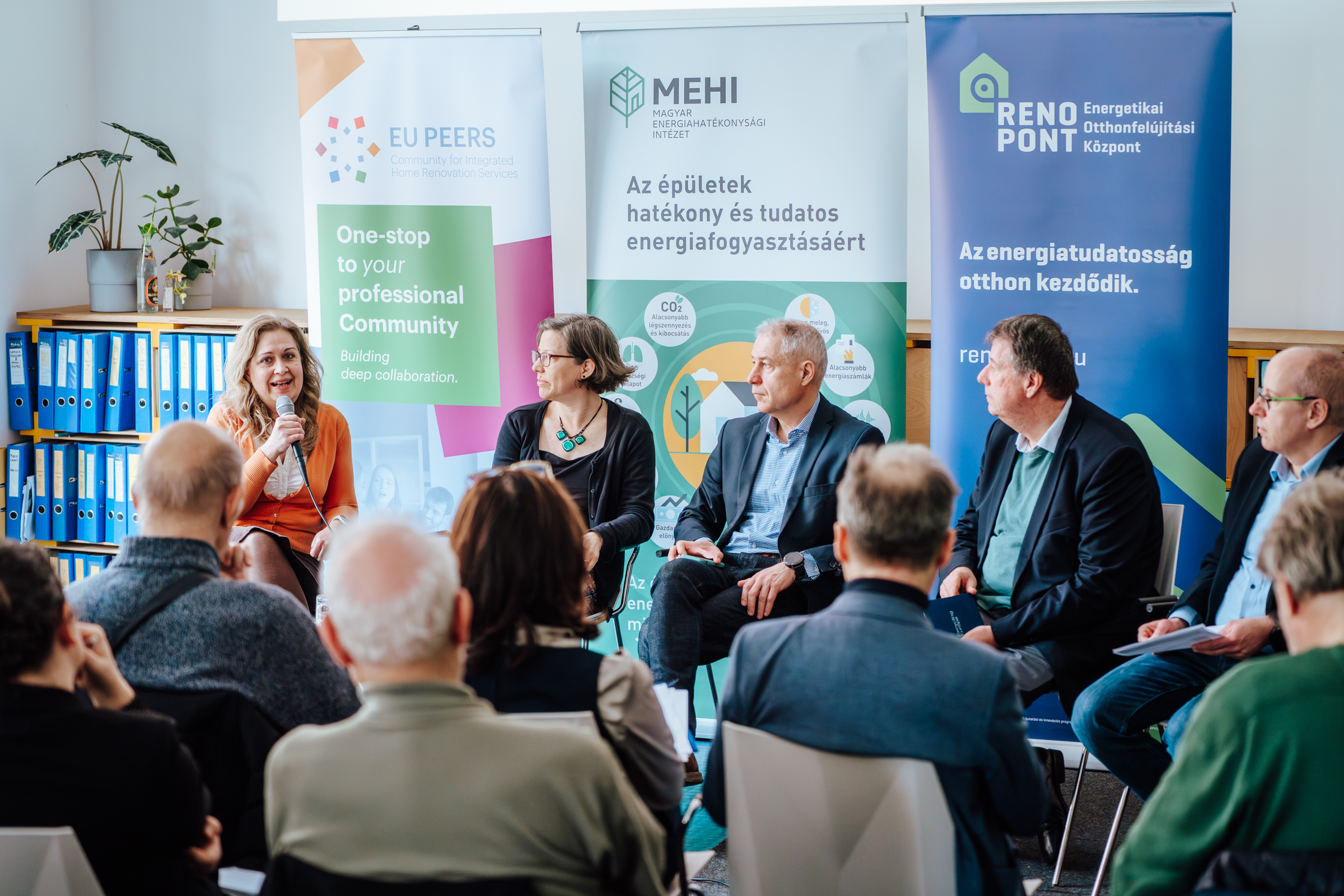
Participants in the first roundtable discussion agreed that the directive alone will not solve anything, but it provides an important framework for Hungary to finally begin modernising its building stock on a systemic level. Zsuzsa Szalay (Budapest University of Technology and Economics), Zsuzsa Koritár (Habitat for Humanity Hungary), Károly Oelberg (AACM), and Gábor Szarvas (Hungarian Green Building Council) discussed the need for renovation programs to begin as soon as possible, even if they are not perfect. The speakers highlighted the role of one-stop shops and renovation passports, as most households are unable to decide on their own what the correct order of renovation measures is.
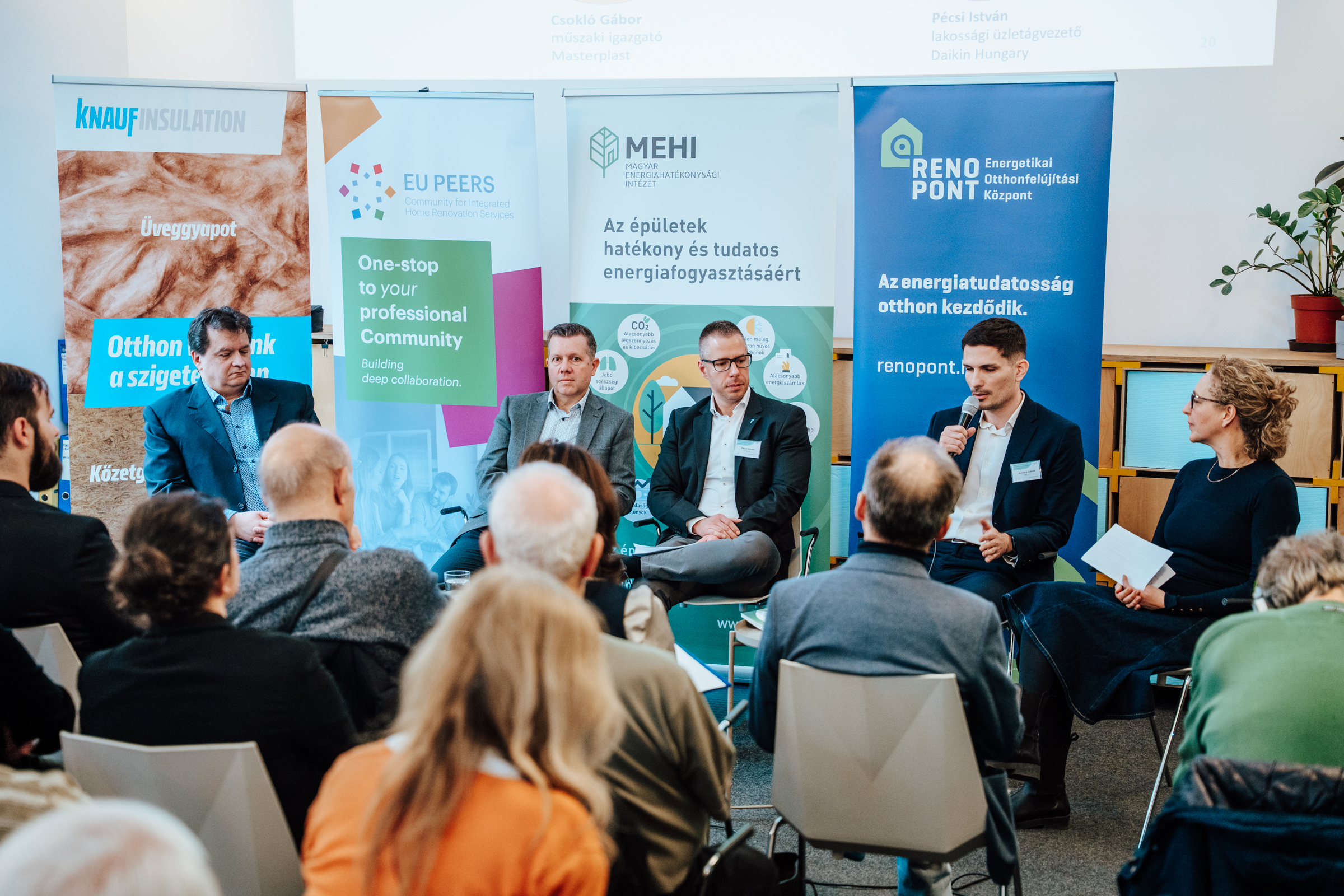
The participants in the second roundtable - executives from building materials manufacturers - Gábor Kovács (VELUX), Gábor Csokló (Masterplast), Tamás Aszódy (Knauf Insulation), and István Pécsi (Daikin) - agreed that the direction of the regulations is clear, but the key to success lies in predictability, a stable subsidy environment, and the involvement of industry stakeholders. They agreed that there is a need for simple, large-scale, and long-term predictable programs, which must also be supported by one-stop shops. According to the participants, a stable regulatory environment, clear communication, and a consistently implemented, long-term renovation path is essential.
The chapter of the handbook on one-stop shops was written by Ilona Illésné Szécsi, project leader of the EU Peers project in Hungary, who provided a detailed overview of the current state of one-stop shop services in Hungary and of service providers operating under the advisory, support, and implementation models. She formulated recommendations for establishing an effective system, a key element of which is the creation of a one-stop shops through cooperation between state organizations, county and municipal governments, civil society organizations, and market-based OSSs, with information campaigns and awareness-raising playing a prominent role. 
The EU Peers project (101120790 LIFE22-CET-EU Peers) is co-funded by the LIFE Programme of the European Union.