There are many claims circulating around about wind energy - we’ve collected the most common, frequently asked questions and misconceptions, and we provide clear and easy-to-understand answers to them.
- Is it true that there’s not enough wind in Hungary?
-
💨 Hungary can be considered completely average when it comes to wind - it is neither windier, nor less windy than the European average. Wind turbines could be operated economically on about 70–80% of the country’s territory. This is also demonstrated by the fact that in 2024, there was a multiple oversubscription for the newly issued grid connection permits. These applicants decided to invest in wind power on a market basis, taking on the responsibility and risks - because, it pays off, according to their calculations. What’s more, modern turbines can already operate even in lower wind conditions.

- Aren’t these huge wind turbines ugly and disturbing?
-
🌾 The best answer would come from those that live nearby of wind turbines - and generally, they don’t complain. Several mayors have confirmed that local residents are not bothered by the turbines, even in places where they’ve been operating for decades.
Let’s look around: high-voltage power lines, dangling cables, noise barriers, coal and gas power plants - we’re surrounded by “ugly” infrastructure. A wind turbine isn’t much different - the only excepttion is that it produces clean energy.

- Is burying wind turbine blades the only option?
-
🔧 90% of the blades can be recycled. They’re turned into rain shelters, bike racks, and playground equipment - and at a conference, we have even met a speaker who proudly showed off shoes made from wind turbine blades. It’s true that this isn’t the norm yet, but there are already several companies that recycle thousands of tonnes of blades each year. This is one of the key areas where the technology is constantly evolving.

- Is it really worth building wind turbines in Hungary?
-
⚡ Yes, absolutely - in fact, wind turbines in Hungary have an annual capacity factor of 23–24%, which is above the European average. Newer models already operate at over 30% efficiency. For comparison: solar power plants have a capacity factor of around 16% - and they’re still worth it.
Wind energy is now the cheapest form of electricity generation.
- Is it true that wind turbines don’t pay off and have to be dismantled after 20 years?
-
Wind turbines have a lifespan of 25 - 30 years, and the cost of dismantling is already factored into the installation budget. Once they age, new, more modern turbines can be installed in their place.
According to a comprehensive analysis, a wind turbine produces the same amount of energy in just 3-7 months as it was necessary to its manufacturing, transport, installation, and commissioning - and from then on, it generates clean energy for decades.
⏳ Just think about it: it doesn’t need “fuel” - the wind itself is free. That gives it an exceptionally good energy balance over its lifetime. And its total lifecycle greenhouse gas emissions are among the lowest of all energy generation technologies.

- Is it true that wind turbines only produce electricity 10% of the time and not when it’s even necessary?
-
Hungarian wind turbines have an annual capacity factor of around 23–24%, and for newer models, this can exceed 30%. At heights of 200 meters, there are virtually no windless hours. However, it is true that balancing is needed in the system.
🕹️ At the same time, wind turbines can be “curtailed“ - meaning that even if the wind is blowing, the blades can simply be turned out of the wind to stop production when electricity isn’t needed. This ability to scale down is a major advantage, especially compared to nuclear power plants, where such flexibility is much harder to achieve.

- But wind turbines aren’t even banned in Hungary!
-
📜 It’s true that there was no official ban, but a regulation in 2016, effectively made construction impossible by requiring a 12 km buffer zone from any inhabited area - and such places simply don’t exist in Hungary. There’s not a single point in the country that isn’t within 12 km of a settlement.
In 2024, this distance was reduced to 700 meters, so the issue has now become obsolete. However, in our view, the regulation still needs to be reviewed and improved in several areas.

- Do wind turbines really make people sick because of infrasound?
-
Infrasound is a very low-frequency sound (below 20 Hz) that the human ear cannot hear. Wind turbines do emit infrasound, but at levels so low that there is no detectable physiological effect - this has been confirmed by dozens of studies.
🔊 Many other things also generate infrasound: storms, wind blowing through trees, the roar of the sea, and even household appliances like fridges and air conditioners. According to one study, infrasound would need to reach around 110 decibels to cause dizziness or nausea - which is orders of magnitude higher than what a turbine emits. (110 dB of infrasound is like being at a rock concert or under a low-flying jet.) No wind turbine generates infrasound anywhere near that level.
The so-called „wind turbine syndrome” is considered by many to be psychological in origin: people who are already anxious about turbines may experience symptoms due to the nocebo effect (symptoms triggered by negative expectations). For example, a 2012 review collected 198 (!) different complaints linked to wind turbines - from headaches and cancer to claims that “chickens stop laying eggs” nearby. None of these have been scientifically proven.

|
- Are wind turbines really dangerous for birds?
-
🌳 In this video, an ornithologist refutes these claims, and the mayor of Sopronkövesd also speaks up, saying that he regularly walks the area around the turbines and has never come across a dead bird. The key, of course is, to choose the location of the wind turbine properly. Wind farms can only be built with permits, following thorough assessments - nature protection is an integral part of the planning process, not something addressed afterwards.
According to a study, domestic cats kill a thousand times more birds than wind turbines - and even cooling towers or buildings claim far more victims. Moreover, the latest wind turbines now offer technological solutions to protect bats as well.

- Does a wind turbine really destroy nature and habitats?
-
🌿 It can’t be built just anywhere - it’s not permitted in protected areas or habitats of rare species. The location is always carefully assessed, and turbines are typically placed on agricultural or other already-used land.
Of course, there’s no such thing as an “invisible power plant” - but the scale of intervention matters.
A coal power plant, a mining site, or a gas field developed through fracking causes far more drastic environmental disruption: deforestation, soil and water pollution, and so on. In contrast, a wind turbine takes up very little space (we’re talking about 0.1 hectares), and it doesn’t pollute, use water, or generate waste during operation.
We need to weigh the options: the ecological footprint of wind energy is significantly smaller than that of fossil alternatives.

- Are wind turbines really that noisy?
-
🌬️ We’ve often stood directly beneath a wind turbine - and the sound of wind was even louder than the turbine itself. In fact, measurements show that even a refrigerator is louder. And if you don’t trust the strict noise regulations, we can only say: ask the locals who’ve been living near them for decades - there are no complaints about the sound of wind turbines.

- Is it true that wind turbines aren’t environmentally friendly because they require massive concrete bases and tree cutting?
-
🏗️ In fact, wind energy is one of the most environmentally friendly ways to generate electricity when looking at the full life cycle. A turbine offsets its CO₂ emissions within six months and then continues to operate for another 25 - 30 years. The cost of dismantling is already included in the planning at the time of installation. Additionally, compared to solar power plants, wind turbines require only a twentieth (5%) of the land area.

- Are wind turbines only profitable with government subsidies?
-
📈 In the past, it’s true that they received state support, but today such investments are worthwhile even without subsidies. By now, it’s clear that investors build wind turbines because these projects are predictably and sustainably profitable in the long term.

- Do wind turbines often just stand still because the wind doesn’t always blow?
-
💨 Wind is indeed weather-dependent, but that doesn’t mean turbines are constantly idle. A modern wind turbine generates at least some electricity most of the time - onshore wind farms typically operate at some level about 80% of the year. If you do see a turbine standing still, there can be several reasons beyond the calm weather: maintenance, intentional shutdowns (e.g., during bird migration), or extremely strong winds that could damage the turbine or cause overproduction in the grid.

- Is wind energy unreliable? If we still need conventional power plants, doesn’t that make wind energy “pointless”?
-
💡 A well-designed system and a smart grid is of key importance: wind energy, as part of the so-called energy mix, actually increases supply security.
Given our growing energy needs, it makes sense to use every available energy source - especially those that are as environmentally friendly and economically viable as possible.
🔋 To simplify, the Hungarian energy system works roughly like this:
- There’s a more or less continuous producer (Paks nuclear power plant),
- alongside flexible (e.g., gas-fired) power plants,
- and partially unpredictable sources (like solar panels).
The system always needs to generate exactly as much electricity as households and the economy are consuming at any given moment. That’s why we have power plants that can ramp up or down as needed - typically gas plants. When that’s not enough, we import electricity (often a lot, and often at high prices), fire up other fossil backup plants (oil), or try to ramp up the lignite-burning Mátra Power Plant - which is expensive and extremely polluting.
Now, this whole system would benefit greatly if we had about half as much wind capacity as we currently have compared to the solar.
Every windy hour means less fossil fuel needs to be burnt. The more wind energy we have, the less we need to import or rely on expensive, polluting backup power plants. Wind doesn’t replace everything, but it reduces fossil dependence - and every windy hour saves fuel, money, and emissions. In fact, the more widespread wind turbines are, the more likely it is that the wind is blowing somewhere at any given time.

|
- Hungary’s conditions are favourable for the cost-effective exploitation of wind energy.
- Wind power investments no longer require financial support – these projects are now viable on a market basis.
- To ensure a balanced energy system, at least 500 MW of wind capacity should be installed for every 1,000 MW of solar power.
- All things considered, wind turbines offer an environmentally friendly, climate-safe alternative, without causing harm to nature or human health.
- Wind turbines contribute to the country’s energy independence.
Currently, solar energy dominates Hungary’s renewable capacity, but this one-sided development is causing increasing challenges. The highly variable daily and seasonal output of solar power plants leads to more frequent overproduction and energy shortages.
Combining solar and wind energy helps reduce extreme production fluctuations and results in a more balanced system. While solar output peaks in the spring and summer, wind turbines generate more electricity in the winter months. This complementary effect also applies on a daily scale: solar power peaks around midday, whereas wind turbines are typically more active at night.
This complementary effect is illustrated in the chart below: we used real data from 2023 to model how much electricity would be generated if we had half as much wind capacity as we currently have in solar. The result shows that the solar curve is significantly flattened over the year - only December and January remain as months during which wind cannot fully offset the low solar output.
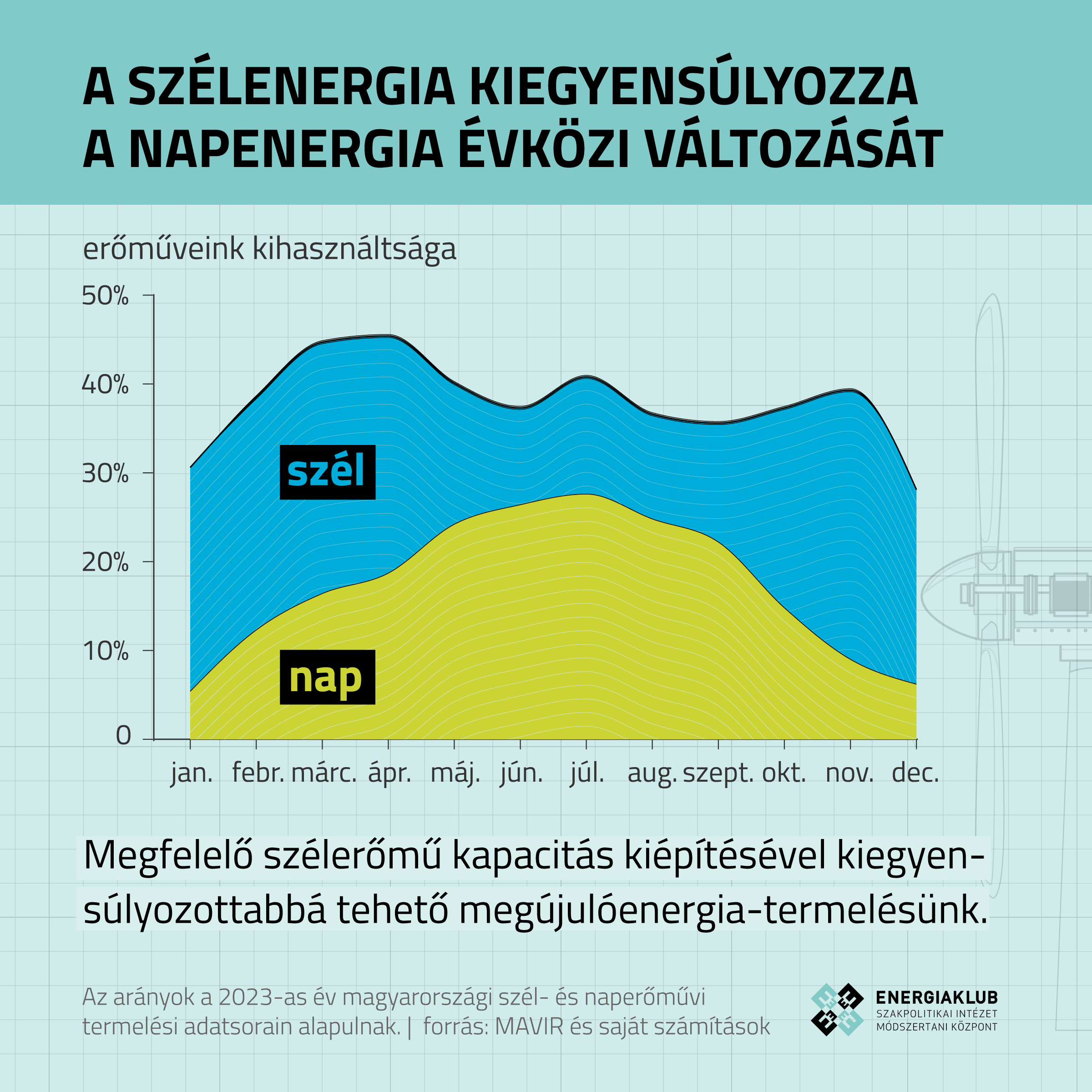
To achieve an optimal balance, Hungary would need at least 4000 MW of wind capacity alongside the current nearly 8,000 MW of solar - yet only 300 MW is currently in operation, and the government’s target is just 1000 MW by 2030. This amount falls far short from what’s necessary for a clean and sustainable energy supply.
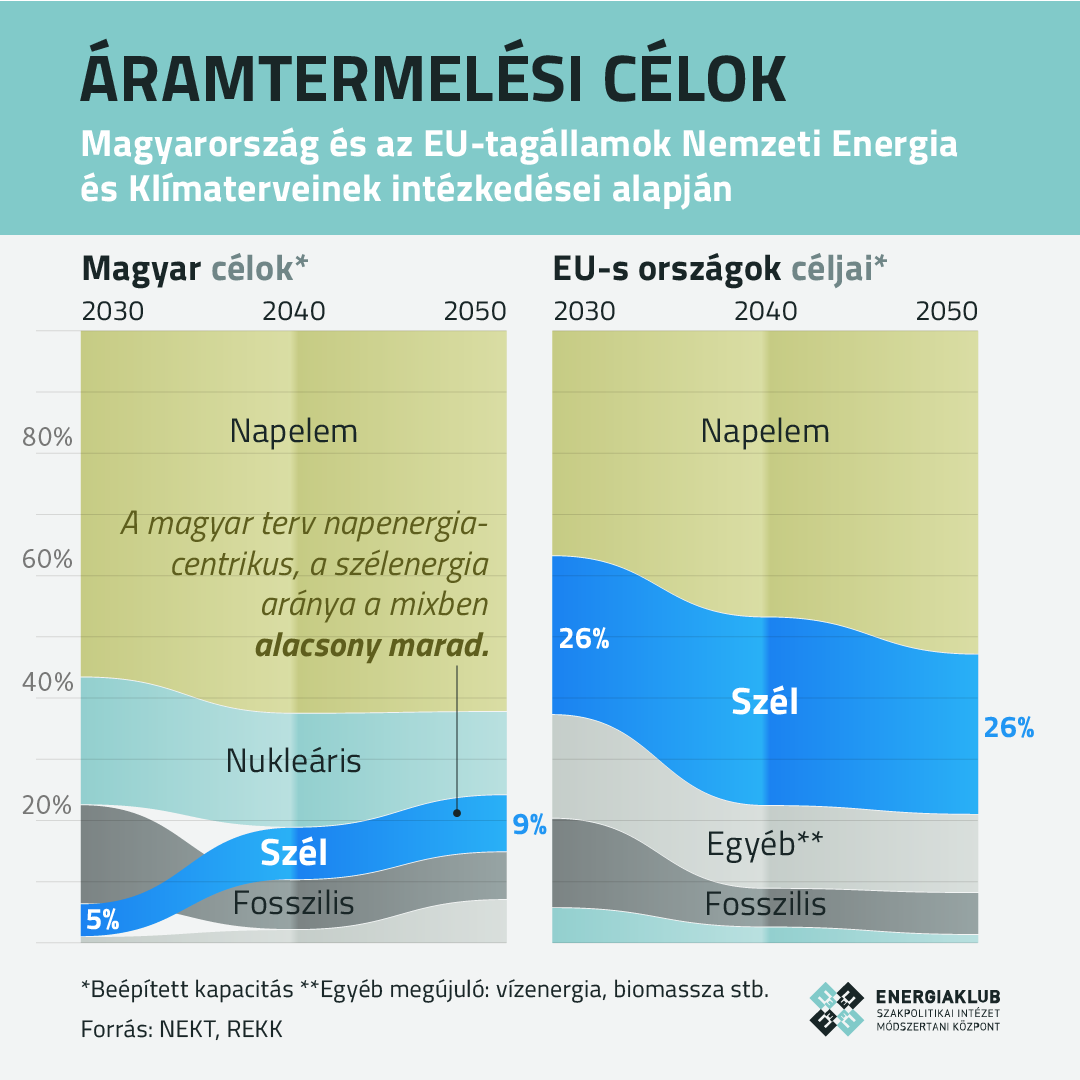
In addition to Hungary’s modest 2030 wind targets, its long-term development plans also lag significantly behind the EU average:
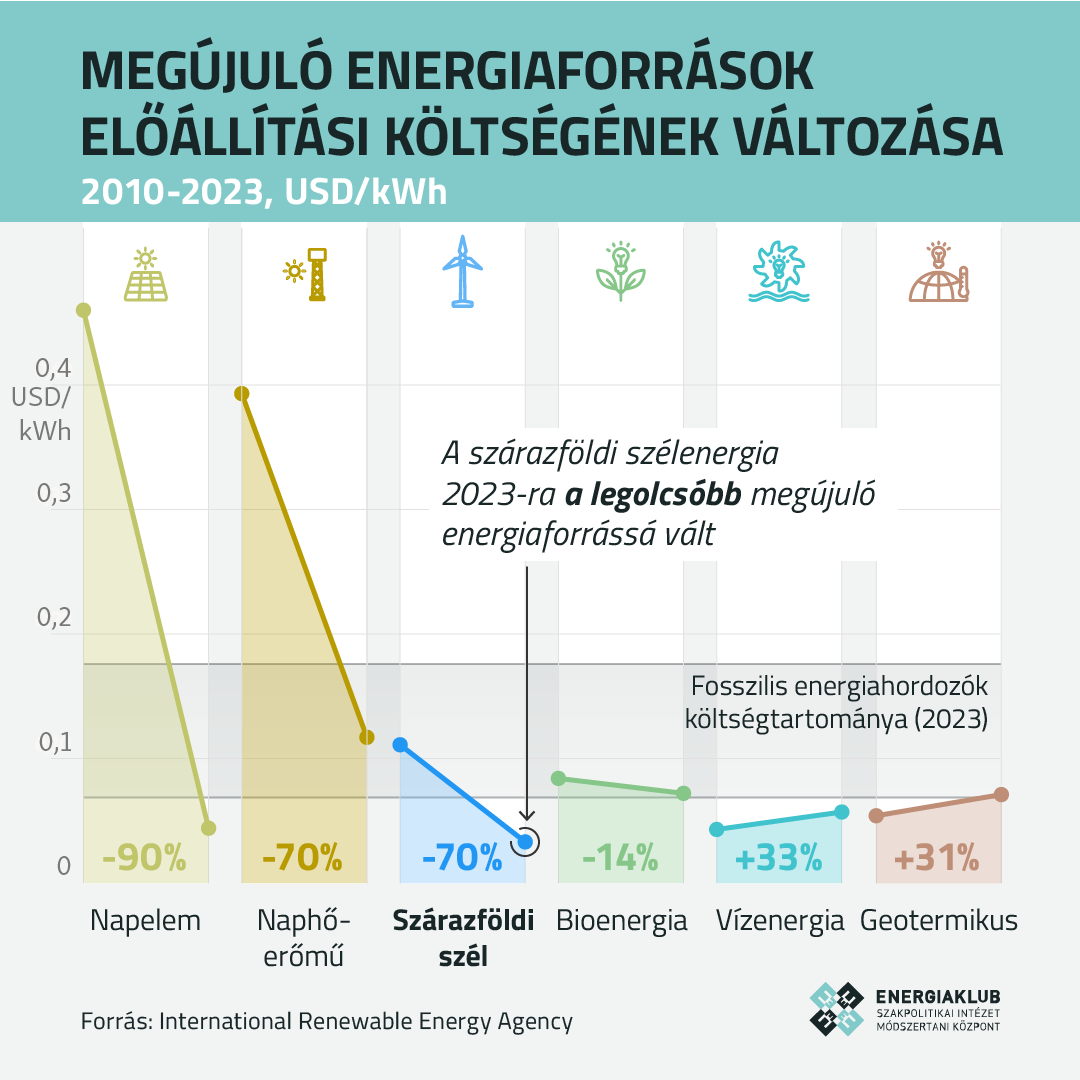
Over the past 15 years, wind turbines have undergone tremendous technological development. Modern turbines now operate efficiently even at low wind speeds, which means they can achieve up to 50% better capacity utilisation under Hungarian wind conditions compared to earlier models built in the 2000s. This progress has significantly improved the economic viability and market competitiveness of wind power plants, helping onshore wind become the cheapest form of electricity generation globally - significantly cheaper than any conventional source, including fossil fuels or nuclear power.
Wind turbines primarily contribute to reducing electricity imports and, secondly, to replacing gas-based power generation. In doing so, they not only increase the share of renewables in the system, but also support the country’s energy independence.
In recent years, Hungary has seen a sharp rise in the number of hours with negative electricity prices - when producers have to pay others to take their electricity - resulting in significant economic losses. Wind energy could be the “joker” solution that reduces import dependence, lowers the need for fossil power plants, and provides cheap, domestic electricity.
One particular advantage of wind is its flexible controllability, which helps save more system-level costs than the additional backup capacity required for its integration would entail.
The future lies in diversified energy production
Wind power no longer requires financial support - these investments are now viable on a market basis. This further increases their competitiveness and justifies their broader integration into the energy mix.
Hungary’s conditions are favourable for the combined use of solar and wind energy. To build a sustainable, cost-effective, and secure energy system, the development of wind energy can be no longer delayed.
Is it true that there isn’t enough wind in Hungary?
Hungary has completely average wind conditions – neither windier nor less windy than the regional average – comparable to Slovenia, Croatia or Slovakia. Around 70–80% of the country’s territory would be suitable for economically viable wind power generation. The average wind speed in Hungary at 200 metres – the height at which modern wind turbines operate – is 6-7 m/s, which is more than sufficient for the efficient operation of modern turbines.
Here's another illustrative fact: Hungary’s average wind speed is actually higher than Romania’s – yet Romania has had 3,000 MW of installed wind capacity for nearly a decade. That’s ten times more wind power than Hungary currently has.
Average wind speed (min and max) by country – at 200 metres above ground:
- Hungary: 4.5–8.5 m/s (8.5 m/s near Sopron and the Bakony Mountains; 4.5 m/s in northern Borsod County). In most of the country: 6–7 m/s.
- Austria: 2.5–11 m/s (11 m/s on Alpine ridges; where most wind farms are located – near the Hungarian border – averages are 7–10 m/s; 2.5–4 m/s in Alpine valleys).
- Slovakia: 3.5–9.5 m/s (9.5 m/s in the High Tatras; 3.5 m/s around Brezno).
- Romania: 2.5–9 m/s (2.5 m/s in valleys of the Southern Carpathians; 9 m/s in the north-eastern Carpathians).
- Serbia: 3–8.5 m/s (3 m/s near the Kosovo border; 8.5 m/s in the eastern mountain areas).
- Croatia: 3–10 m/s (3 m/s around Otocac; 10 m/s in the mountainous northern coastal region).
- Slovenia: 3–9.5 m/s (3 m/s around Kranj; 9.5 m/s in the southern region).
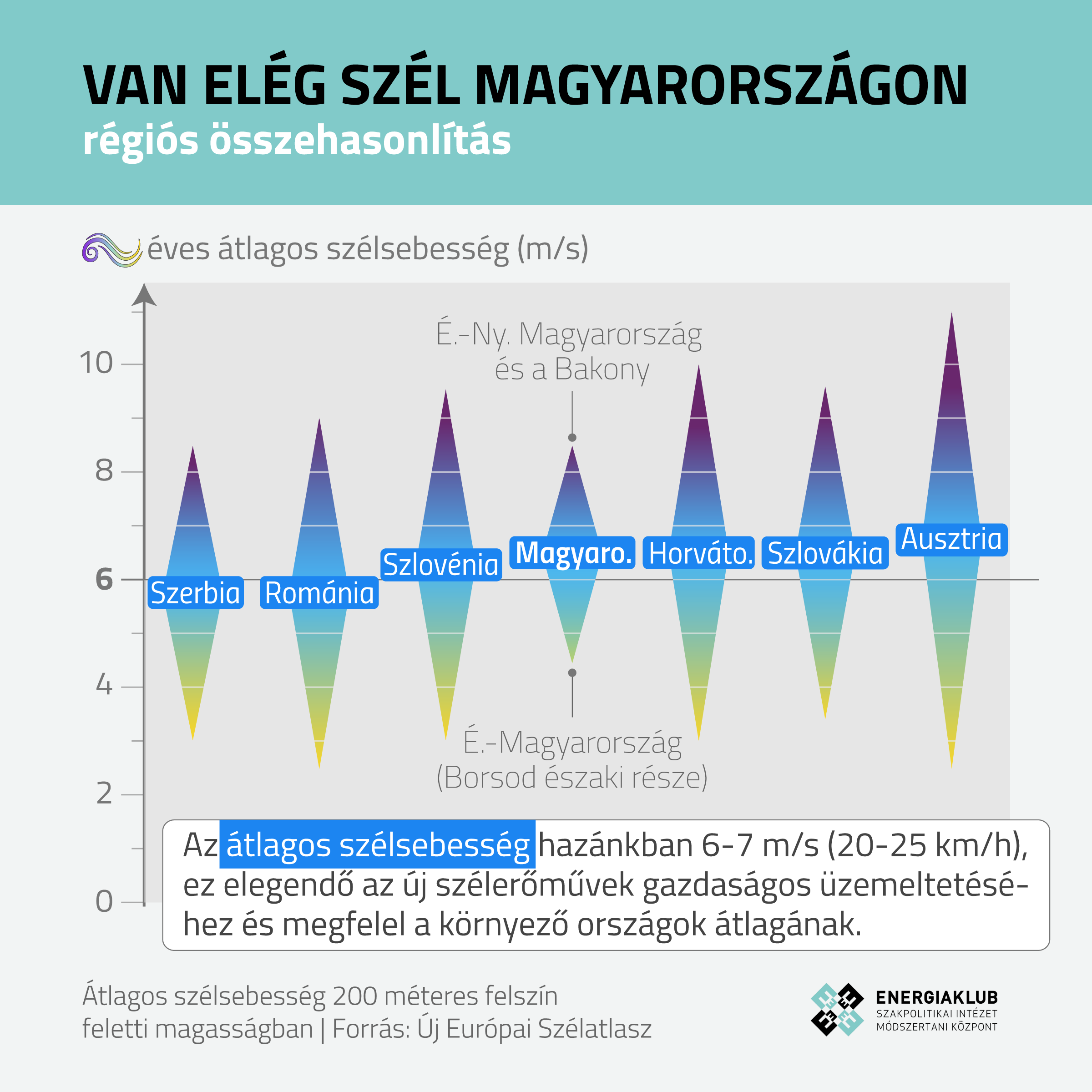
The infographic clearly shows that in our country, the average wind speed is more balanced (with fewer extremes), but most of it is above 6 m/s, which indicates profitability.